Proofs in Python
PyCon Singapore 2026 Edu Summit
Computational Thinkerers
Computational Thinkerers

Spot the bug
Java’s binary search picks the middle index:
int low  = ...                // int is signed 32-bit
int high = ...
int mid  = (low + high) / 2;  // shipped in java.util.Arrays for ~9 years
Looks fine.1
What is the bug?2
Why proofs?
Java’s binary search had a test suite.
- A test suite checks the cases you thought of
- A proof checks all 2⁶⁴ cases at once
But first the proof makes you write the spec.
A Python bug from 2002 to 2015
Timsort in list.sort() was silently broken for 13 years.
- Shipped in Python, Java, and Android
- No test ever triggered it
- de Gouw et al. found it while proving it correct1
Writing the proof forced the missing case into the open.
Back to the binary search bug
lo + hi overflows to a negative int.
from z3 import BitVec, ZeroExt, LShR, Implies, And, prove

lo, hi = BitVec("lo", 32), BitVec("hi", 32)
valid = And(lo >= 0, hi >= 0)                        # real array indices
true_mid = LShR(ZeroExt(1, lo) + ZeroExt(1, hi), 1)  # midpoint, no overflow

buggy = (lo + hi) / 2
prove(Implies(valid, true_mid == ZeroExt(1, buggy)))

fixed = (lo & hi) + LShR(lo ^ hi, 1)
prove(Implies(valid, true_mid == ZeroExt(1, fixed)))
Output
counterexample
[hi = 1874714396, lo = 2069860050]
proved
Replace a loop with an expression
\[ \sum_{k=0}^{n-1} (a + kd) = \frac{n(2a + (n - 1)d)}{2} \]
from sympy import symbols, summation, simplify

a, d = symbols("a d")
n, k = symbols("n k", positive=True, integer=True)

lhs = summation(a + k * d, (k, 0, n - 1))
rhs = n * (2 * a + (n - 1) * d) / 2

assert lhs.equals(rhs)
SymPy proves the general AP formula.
Proofs as functions
pyzar is a declarative proof checker inspired by Mizar/Isar
\[ A \land B \;\implies\; B \land A \]
Assume A∧B, take it apart, put it back together.
from proof import proof
from tactics import CONJ

@proof
def CONJ_COMM(p):
    p.goal("!a:bool b:bool. a /\\ b ==> b /\\ a")
    p.fix("a b")                             # consider some bool a and b
    h = p.assume("a /\\ b")                  # h is our assumption a /\ b
    ha, hb = p.split(h)                      # from a /\ b, get a and b
    p.thus("b /\\ a").by_thm(CONJ(hb, ha))   # recombine, swapped
Proofs in Python
Python can host different styles of proof:
- bit-precise arithmetic with z3
- symbolic algebra with SymPy
- declarative step-by-step deduction with pyzar
Additional content
Verifying a full adder
A full adder has three Boolean inputs:
abcin
It should return the same result as adding the three bits.
Full adder circuit
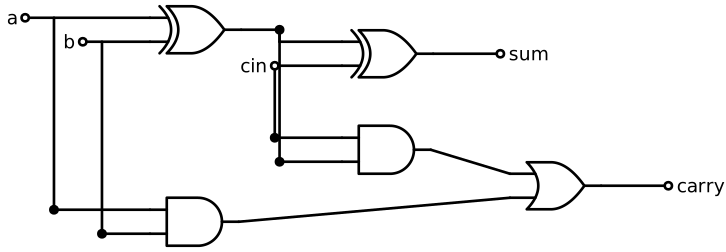
Full adder specification
total = If(a, 1, 0) + If(b, 1, 0) + If(cin, 1, 0)

prove(If(sum_bit, 1, 0) == total % 2)
prove(If(carry, 1, 0) == total / 2)
Output
proved
proved
The two proof calls mean:
sum_bitis the low bit ofa + b + cin.carryis the high bit ofa + b + cin.
A natural deduction proof
\[ A \land B \;\implies\; B \land A \]
mathesis builds a natural-deduction proof backwards.
from mathesis.grammars import BasicGrammar
from mathesis.deduction.natural_deduction import NDTree, rules as R

g = BasicGrammar()
nd = NDTree([g.parse("A∧B")], g.parse("B∧A"))   # premise ⊢ goal
nd.apply(nd[2], R.Conjunction.Intro())          # to prove B∧A, prove B and A  [∧I]
nd.apply(nd[4], R.Conjunction.Elim("right"))    # B follows from A∧B           [∧E]
nd.apply(nd[6], R.Conjunction.Elim("left"))     # A follows from A∧B           [∧E]
assert nd.is_valid()                            # every branch is justified
Proving the halting problem
No program can decide halting:
\[ \neg\,\exists H.\ \mathsf{halts\_decider}(H) \]
where halts_decider H is a program where
(H d)halts ifdrun forever(H d)runs forever ifdhalts
The diagonal does the work
Construct a program d that evaluates to (H d)
\[ \begin{array}{rcll} d & \twoheadrightarrow & \mathsf{App}_t\,H\,d & \text{(diagonal)}\\ \mathsf{halts}\,d & = & \mathsf{halts}(\mathsf{App}_t\,H\,d) & \text{(reduction)}\\ \mathsf{halts}\,d & = & \neg\,\mathsf{halts}(\mathsf{App}_t\,H\,d) & \text{(decider)}\\ \hline \mathsf{halts}(\mathsf{App}_t\,H\,d) & = & \neg\,\mathsf{halts}(\mathsf{App}_t\,H\,d) & \text{($P=\neg P$)} \end{array} \]
Sketch of the pyzar proof
@proof
def HALTING_UNDECIDABLE(p):
    p.goal("~ (?H. halts_decider H)")
    with p.suppose("?H. halts_decider H") as h_ex:
        h_diag = p.have("?d. halts d = halts (App_t H d)").by(..)
        d = p.choose("d", from=h_diag)
        # d reduces to App_t H d, therefore
        # halts d = halts (App_t H d)
        ...
        H, _ = p.choose("H", from=h_ex)
        # H decides halting (flipped), therefore
        # halts d = ~halts (App_t H d)
        ...
        # contradiction